Markerless bilateral tracking
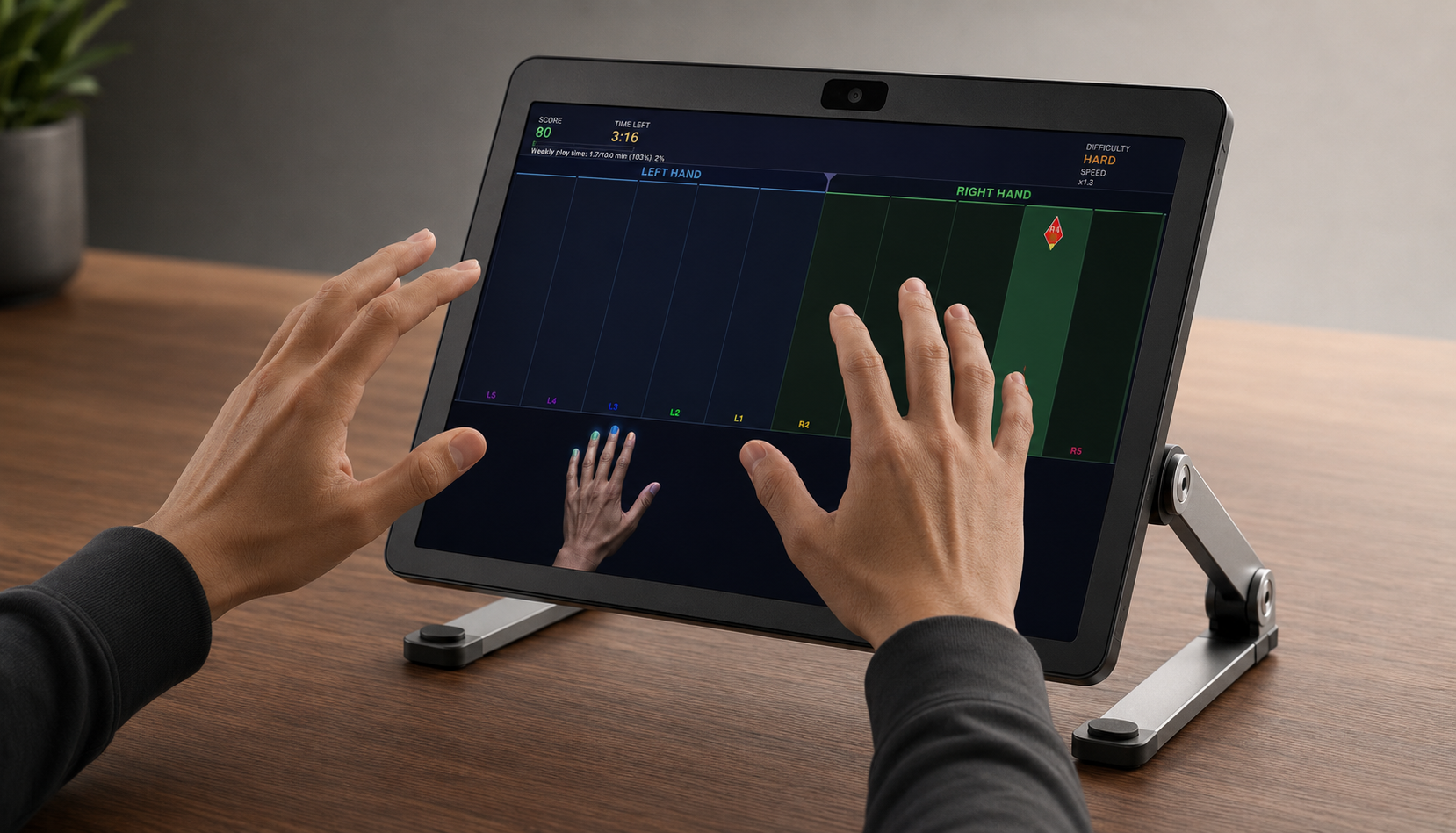
Camera-based hand tracking captures both hands simultaneously without gloves, sensors, or specialized motion-capture equipment.
VR hand rehabilitation
A home-based virtual reality platform designed to help people rebuild hand dexterity after degenerative cervical myelopathy surgery through markerless tracking, serious games, adaptive difficulty, and objective performance feedback.
Concept rendering. Final device design may change.
Clinical need
Degenerative cervical myelopathy is the most common cause of non-traumatic spinal cord injury. Surgery can decompress the spinal cord, but many patients continue living with impaired fine motor control that affects handwriting, typing, utensils, tools, work, and independence.
Current home programs rely heavily on conventional therapist-prescribed exercises. They are difficult to standardize, hard to track objectively, and often do not deliver the high-repetition, task-specific practice needed for meaningful hand recovery.
The platform
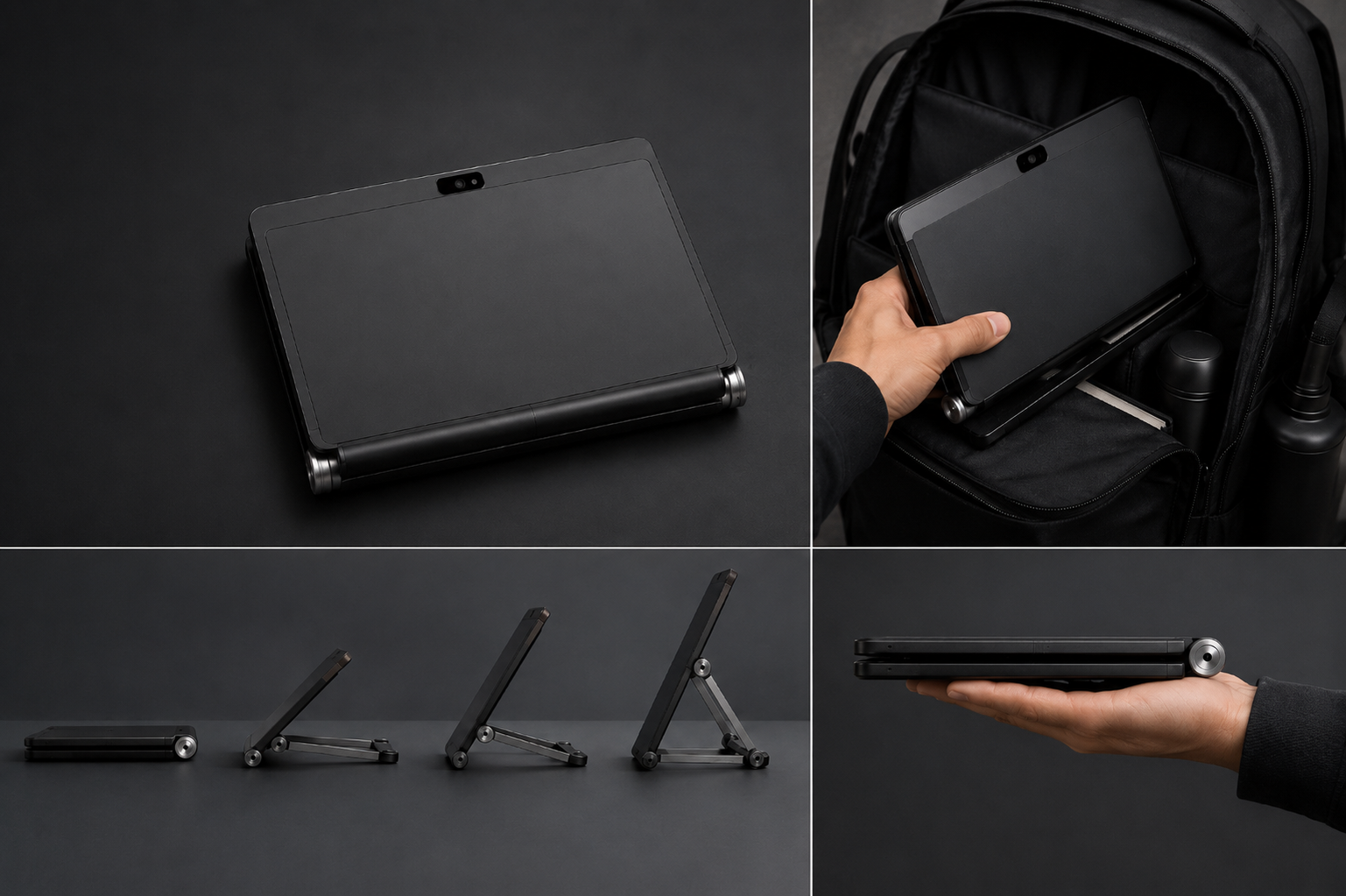
Motion Health is developing a self-contained VR rehabilitation device that tracks both hands without gloves or wearable sensors and adapts therapy difficulty based on performance.
Camera-based hand tracking captures both hands simultaneously without gloves, sensors, or specialized motion-capture equipment.
Therapy tasks train finger individuation, bilateral coordination, timing, accuracy, and suppression of unintended adjacent-finger movement.
Performance-responsive rules adjust task challenge using accuracy, reaction time, error rate, completion, and tracking quality.
Evidence base
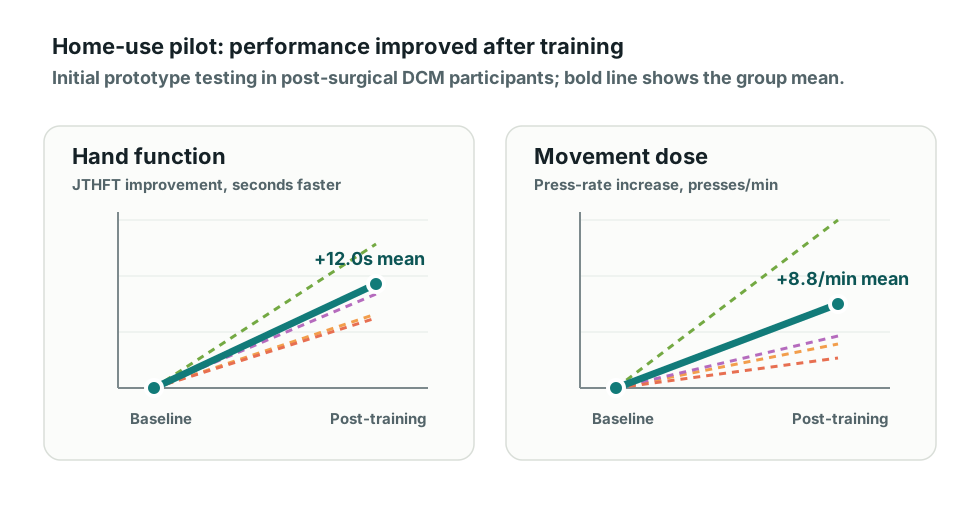
Motion Health's VR hand-training approach has been tested in post-surgical DCM participants, with early clinical and home-use results supporting continued device development.
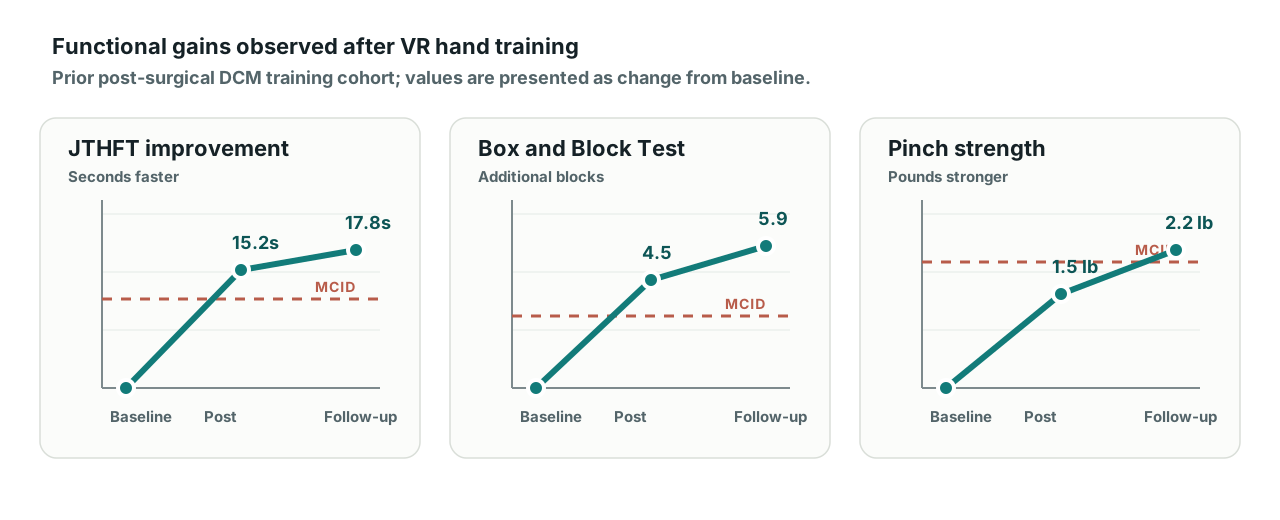
A 4-week clinical training cohort in 22 post-surgical DCM participants showed sustained improvement in hand dexterity after VR hand training.
An initial home-use pilot with 4 post-surgical DCM participants completed prescribed sessions and supported feasibility of the markerless platform.
Training emphasizes high-intensity, task-specific repetition with multisensory feedback and individualized challenge.
Device development
Development is focused on making the system simple to set up, reliable in real homes, clinically meaningful, and practical for patients to use consistently.
The next-generation device is being refined for independent setup, reliable bilateral tracking, automated calibration, objective performance capture, and adaptive difficulty.
Motion Health is preparing the platform for broader home deployment, clinical workflows, service support, and commercialization conversations ahead of a future launch.
Commercial path
The first market is post-surgical DCM patients with residual hand impairment: a defined clinical population with a clear treatment pathway through spine surgery and rehabilitation clinics.
The same software-centered architecture can be adapted for other neurological and musculoskeletal conditions associated with impaired finger individuation, coordination, and hand dexterity.
Contact
Motion Health is preparing for a future launch and welcomes conversations with clinical, rehabilitation, product, and commercialization partners. The form opens a prepared email so the site works without a backend.